There's more than one kind of feedback
Most corporate feedback is couched in the whole SMART/actionable/urgent kind.
Feedback should be given in the moment, when you observe something. You should be clear, have evidence, make it actionable.
But. thats not how ALL feedback works. That’s a specific kind of reactive feedback. That isn’t the only kind!
SMART feedback isn’t dumb
I think that the framing of feedback being specific, actionable, timely and all that is good. It helps you provide useful observations to your colleagues in a way that helps avoid bias and makes it most likely to be useful. Thinking of feedback in this way can transform something like
That presentation was great but the end felt a little weak 1
into something much better like
That presentation was great - I love the use of emojis to bring a bit of playfulness and joy, it really helps keep everyone’s attention. The end felt like the energy went away though. I know its important to make sure your overall message is clear, but it felt like it was an entirely different presentation. I think it would have been better if you kept the tone all the way though - I was fully on board with it!
Notice in my (painfully cliche) example above (…about presentations), I am bringing specificity about what I thought was ‘great’ or ‘weak’, with evidence and a way to make it actionable.
But this style of feedback doesn’t work when it comes to the classic performance reviews. By definition, annual performance reviews are ….annual (or fine, some places do them every 6 or even 3 months). What do you do with them?
I think the “corporate” ideal is that you have been continually giving feedback like the one above all year long. And that you’ve been carefully documenting it every time so you can refer back to it later on. And that you’ve been giving it to everyone you work with - peers, direct reports, managers, so that you have something ready to use no matter who you get asked to provide feedback for at the end of the year. But in reality, this isn’t how the world works.
All models are wrong. A 2x2 model is useful
This time around the performance-review rodeo I found myself thinking a lot about what good feedback looks like in the real world. And I “invented” this2:
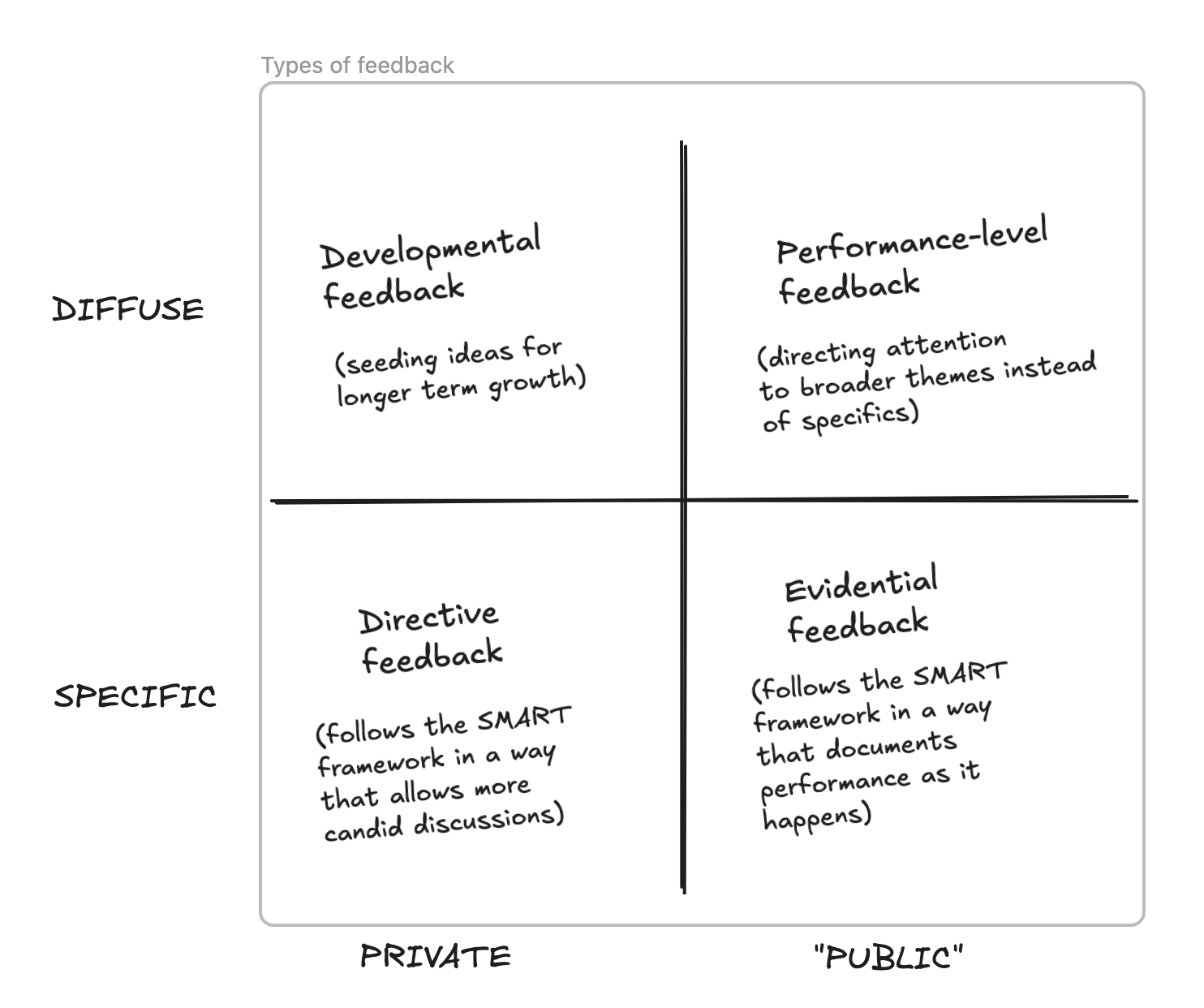
This little 2x2 tries to capture some differences I find useful when thinking about feedback - the way this feedback was generated (from something specific or something more general that you noticed?), and who the “real” audience is (is it for the reciever, or is it for some third party?)
I think all four quadrants of feedback are valid and useful - assuming you use them thoughtfully (i.e. don’t do only one kind)
The feedback source
Specific
The “classic” feedback is specific and reactive - you are telling someone something specific after making an observation, as well as hopefully sharing the impact it had and/or what to change next time.
“In that meeting, you cut over Joe three times. It would be better if you were able to catch yourself doing that and stop, or hand the space back over to Joe”
“You made a point of sharing credit for fixing that production incident - Jane is really quiet so I appreciate you making sure her contributions were noticed”
Diffuse
This is closer to the fuzzy, maybe wishy-washy feedback that can sometimes be discouraged. It isn’t triggered or generated by a specific observation. It typically comes from spending a bit of time reflecting and seeing what connections or patterns you find. These don’t typically happen spontaniously; I find these thoughts come when I set aside some time during the performance review season to think critically about my colleagues and what it’s been like to work with them.
“I feel like you have a lot of good ideas that don’t really go anywhere, but I don’t know why. I think you could be so much more effective if you found a way to make your ideas into reality.”
“For whatever reason, I have fun working with you; I know it’s going to be a good day if we end up working on the same issue.”
These are so vague! They could be totally made up!
The first one is wholly unevidenced, and the second one is just wooly fluffy “this is good”!
What is anyone supposed to do with them??
Unsurprisingly given the theme of this post, I think they are still useful and valid feedback that should be shared.
Why? They allow you to discuss things that simply wouldn’t come up otherwise.
The magic idea that turns these from wishy washy statements to actually useful feedback is realising that it’s entirely the receiver’s choice whether to pay attention to them or chuck them straight in the bin. Put another way, because they are fuzzy and inexact, and are generated with partial context at best, the reciever can (and should!) evaluate whether the feedback is valid or useful 3, and therefore what they want to do with it.
What’s really great about this kind of feedback is, if there’s a sufficient foundation of trust between the giver and reciever, it can lead to a really interesting discussion - What gave them the impression? What context were they missing? What are you curious about? This feedback and the following discussions can plant the seeds for someone’s long term growth.
The feedback audience
The other axis is about who you are really writing this feedback for.
In the real world, you are very likely to change what and how you say something when you know the conversation is being listened to - especially when discussing something as delicate as feedback and performance reviews. So I think its useful to think about this explicitly.
The named person
The ‘classic’ case - the feedback you’ve thought of or written is for the named person. Ideally this is private (or rather, hands control over to the receiver to choose if/how to share), and can rely on whatever shared context or understanding you already have.
For constructive or coaching feedback, this can be hard and scary, but should be the default, or at least your first port of call for a new piece of feedback you want to give to a person.
A third party (often also known as: their manager)
This is the actual case for most performance review feedback. Sure, you’re writing about someone, but your target audience is their manager. This means the purpose of your feedback is no longer about providing direct encouragement or tips; it is now documentary, as you are helping collect evidence of their performance level. And you now have to bear in mind - the shared context between the three of you is smaller, and that what you share has the risk of being used in an unnuanced way.
This means people (yourself included) will inevitibly shape the feedback to match the impression that you want to leave behind. It’s worth being aware of this tendancy!4
I think one of the core rules of this kind of feedback is that it shouldn’t be the way that you share any piece feedback for the first time 5. Or if it is, you have a private conversation with the named person first, before sharing it with their manager.
About performance review feedback, again
Over a full 12 (or 6, or even 3) month period, its hard to be sure that you have included (or even remembered!) all relevant aspects of your working relationship and interactions with a person.
So it seems obvious to me that this process should be driven more than one approach:
- Recounting particularly memorable events and recounting them in the SMART format
- Reflecting generally on working with that person, and summarising the observations, themes, and questions that you find
And then deciding which of those you think need to be documented formally in order for them to be given a fair and accurate rating, and which are best being shared in a more private setting.
Final note(s)
Giving feedback is hard, and giving performance review feedback especially so.
I think its important to make sure you try really really hard to Say The Thing, both to the person directly and to their manager - because ultimately you are doing yourself, your colleague, and your company a disservice if you choose to stay quiet.
-
incidentally, this is actually better feedback than your ’normal’/average “that was great” ↩︎
-
This is obviously a gross oversimplification of the real world. But - all models are wrong, but some are useful, and I think this one is useful. ↩︎
-
(or - as with all feedback - if valid and useful, whether the topic is something they care about improving on) ↩︎
-
And note that being aware of the tendency isn’t an endorsement of it. Ideally you would give feedback like this in the purest possible way - focusing purely on the facts and the evidence you have, giving no thought to what would come after. But we’re all human, so lets just acknowledge that we can’t do this. And we live in the real world - where things can and do get taken out of context (with or without intent) ↩︎
-
Context is everything, nothing is universal etc etc. Especially when you are talking about someone much more senior to you and/or has direct authority over you. I’ve had a few situations in my career where I’ve had such a bad time trying to talk to a someone about how their performance and behaviour was impacting the people around them that I felt I had no choice but to route it to their manager and ask/hope that they did something with the information. ↩︎